
When the CRM Is Allowed to Say “No”
Most CRM systems are designed to keep things moving. Deals advance, stages change, and records flow forward with minimal resistance. From the outside, this looks healthy. Activity is visible, pipelines feel alive, and progress appears constant.
Yet many of the most damaging CRM failures begin in systems that never say no.
Not loudly, and not explicitly. Quietly.
A deal moves forward even though key information is still assumed. A stage changes even though readiness was never agreed. A downstream team starts acting on data that looks complete but is not reliable yet. The system didn’t malfunction. It did exactly what it was allowed to do.
The real question is not whether a CRM can enforce rules. It is whether it is ever allowed to stop progress.
On this page
Toggle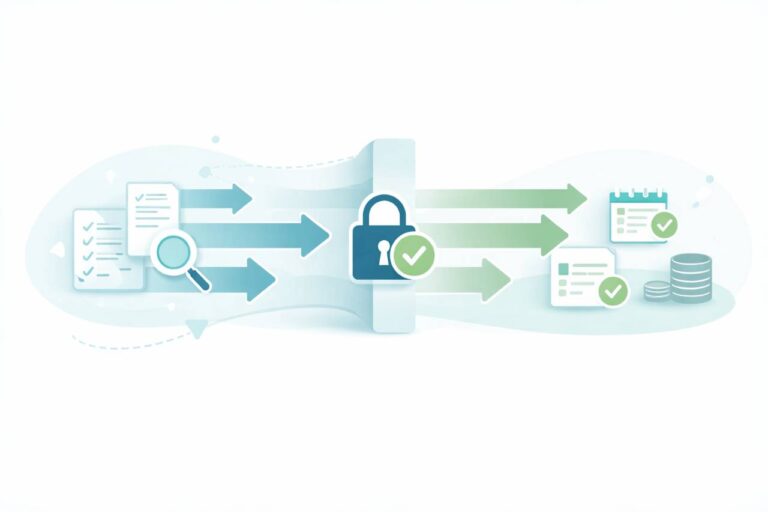
Flow Is the Default – Enforcement Is a Decision
CRMs are built to accommodate motion, and that bias toward flow is intentional. Sales teams need momentum, management needs visibility, and operations needs signals. Systems that block progress too aggressively are quickly bypassed or ignored, so most platforms err on the side of allowing movement.
Flow, however, is not neutral.
Every time a record advances, the system is implicitly making a claim that something is ready enough to be treated as true. If no one explicitly defines when that claim is valid, the CRM will still make it based on whatever information happens to be present at the time.
In practice, this means systems rarely stop people from doing the wrong thing at the wrong moment. They only stop what was explicitly forbidden. Everything else passes through. Over time, this creates a dangerous dynamic where the CRM amplifies optimism instead of reflecting reality.
The Cost of a CRM That Never Pushes Back
In many mid-sized organizations, the CRM never explicitly refuses progression. Required fields are filled, stages are advanced, and pipelines continue to move. From the system’s point of view, everything looks compliant.
The cost of this design choice appears later.
Pricing needs to be revised when assumptions surface. Operations prepares for work that turns out not to be ready. Management asks why numbers changed “suddenly,” even though the data was fragile all along. None of this feels like a system failure because the CRM never claimed certainty outright. People inferred it from movement.
A system that never pushes back does not prevent mistakes. It simply postpones them until they are more expensive.
Saying “No” Is Not About Control
When the idea of blocking CRM progression is raised, it often triggers resistance. People worry about slowing sales, over-formalizing work, or forcing certainty too early in the process. Those concerns are valid.
But allowing a CRM to say no does not mean freezing work or demanding proof before it is useful. It means being explicit about what kind of claim the system is allowed to make at a given moment.
There is an important difference between allowing work to continue and allowing downstream teams to rely on what the system shows. Sales can keep working a deal while the CRM refuses to treat certain values as decision-grade. That distinction is rarely designed intentionally, but it is critical for trust.
Where “No” Actually Belongs
CRMs are not good at judging reality. They are very good at enforcing decisions.
If a system is allowed to say no, it is not because it discovered something was wrong. It is because the business decided that certain conditions must be met before the system is allowed to assert readiness. Those conditions are not universal. They change by stage, by role, and by risk.
Early in a process, uncertainty is normal and often necessary. Later, the same uncertainty becomes costly. Many systems fail not because they allow estimates early, but because they never require those estimates to expire.
When a CRM is never allowed to refuse advancement or clearly define when a record is allowed to move forward, provisional information slowly hardens into fact simply by surviving long enough in the system.
Enforcement is not about stopping work. It is about defining when the system is allowed to assert readiness.
How This Shows Up in Real Systems
In platforms like Zoho CRM — and this applies just as much elsewhere — it is common to see systems that enforce structure without enforcing meaning. Fields exist, stages are defined, and reports run correctly, yet the system never formally asserts when something is not ready to be relied upon.
Some organizations attempt to address this with mechanisms such as gated stage transitions or Blueprint-style rules. Those tools are capable of blocking movement, but without a clear underlying decision about when refusal is justified, they often feel arbitrary or annoying.
The problem is rarely the mechanism. It is the absence of a shared decision about where the system is allowed to push back.
Enforcement Without Killing Flow
The idea that a CRM must either block aggressively or allow everything is a false choice. Effective enforcement does not demand certainty as early as possible. It demands clarity about when certainty is required.
A system that is allowed to say no does not stop work unnecessarily. It does not demand proof before it is useful. It does not assume readiness simply because activity occurred. Instead, it draws a clear line between progress and permission.
Progress can continue. Permission to rely on the data cannot.
That distinction is what many CRMs lack, not because the software cannot handle it, but because the decision was never made.
Why This Is a Design Question, Not a Configuration One
Most modern CRM platforms provide ways to block transitions, require confirmation, or gate progression. Those features are not the hard part.
The hard part is deciding when the system should be allowed to refuse to advance. If that decision is unclear, enforcement becomes arbitrary. If it is never made, enforcement never happens and the CRM defaults to optimism.
This is why enforcement is often experienced as bureaucracy. Rules feel disconnected from real risk because the underlying logic was never articulated. When enforcement is designed intentionally, it stops feeling like friction and starts feeling like protection.
What Changes Once “No” Is Possible
When a CRM is allowed to say no, even occasionally, several things shift. Stage movement regains meaning. Downstream teams trust signals more. Assumptions surface earlier, when they are cheaper to correct.
Responsibility also becomes clearer. Someone had to decide that the system was allowed to block here — which is often part of the broader CRM ownership problem. Someone stood behind that decision. The CRM stops being a passive recorder of activity and starts reflecting actual business posture.
It does not become rigid. It becomes honest.
The Quiet Maturity Test
A useful way to assess CRM maturity is not to ask how flexible the system is or how many features it has. It is to ask a simpler question:
Where is the system allowed to say no?
If the answer is “nowhere,” the CRM will always drift toward optimism. If the answer is “only when formats are wrong,” correctness will remain performative. When the answer is “at the points where readiness actually matters,” the system stops surprising people.
Once a CRM is allowed to say no, the next question becomes unavoidable:
Who is responsible for deciding that refusal is justified — and when?
That is where CRM design either deepens, or collapses back into convenience.